12 / 12 · Tool · 2026
Ozear
A personal issue tracker with its own MCP server: AI assistants log the work and record how the code behind it works.
- Personal tool
- Live
- Built with AI coding agents
- Role
- Product owner, AI-assisted build
- Where
- Personal project
- Year
- 2026
Illustration
How it works
Screen 01
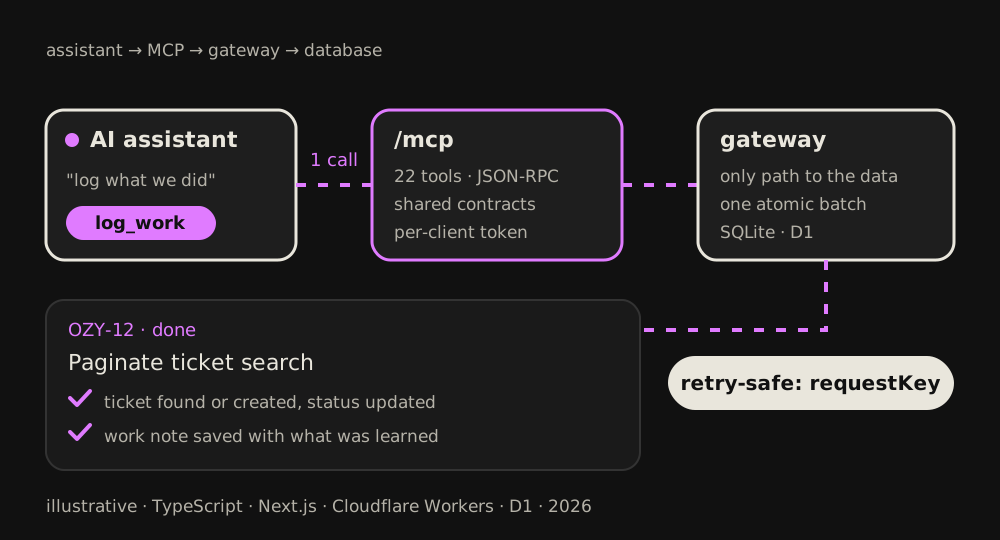
One call, one record
An assistant calls log_work once. The request passes the MCP endpoint and a token-protected gateway, and the ticket and its work note are written in one atomic batch.
Screen 02
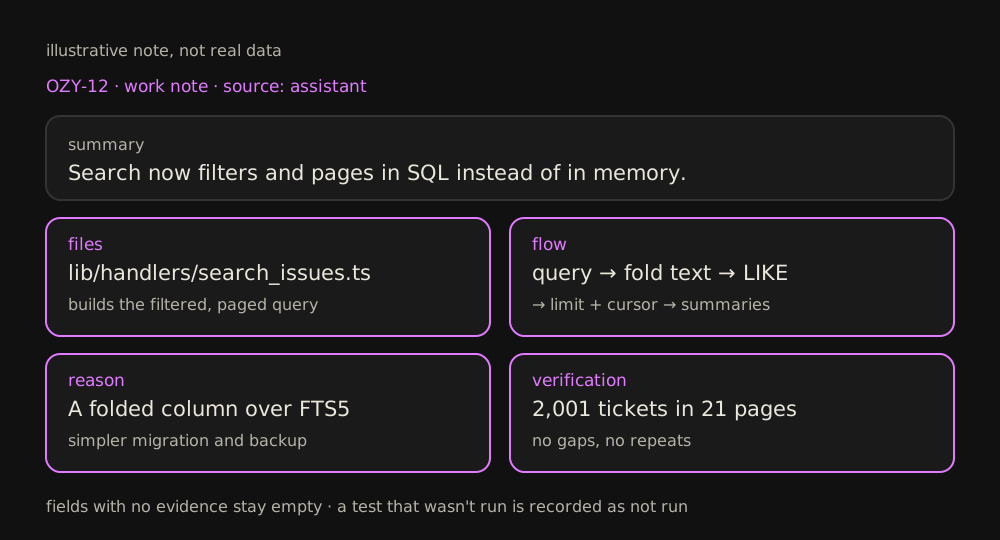
A note that teaches
Illustrative, not real data: every work note can carry the files that were read, how the data flows, why the decision was made and how it was verified.
Presenting? ← → walk through this page, screen by screen, and on to the next project.
Built with
Every layer of the stack, and what it does in this project.
- L1Interface
Projects, tickets, a board and a work journal.
- L2Protocol
22 tools for assistants; accepts protocol versions from 2024-11-05 to 2026-07-28.
- L3Contracts
One set of input rules shared by the web app and the MCP endpoint.
- L4Data
Tickets, work notes and a technology inventory with revision history.
- L5Hosting
The web app and MCP endpoint on Vercel; a Worker gateway is the only path to the database.
- L6Workflow
One agent implements from a written brief; a second model audits the result against the real code and tests.
What I did
Designed the product: a tracker for my own projects where a work note records not just what was done but which files do what, how the data flows, why a decision was made and how it was checked.
Directed the build with AI coding agents instead of writing most of the code by hand: one agent implemented from written task briefs, a second model reviewed and re-tested the result independently, and I decided what shipped.
Writes are retry-safe: request keys, revision checks and atomic batches mean a repeated call from an assistant never duplicates a record or silently overwrites one.
After an audit, the default search response went from 1.24 MB to 11.7 KB and the web app’s first load from 22.6 MB to 102 KB on a synthetic set of 2,000 tickets and 6,000 notes, through SQL-side paging, summaries and indexes.
A single log_work call replaced a four-to-five call sequence for the most common task, recording finished work on a ticket.
Deployed it myself: database migrations, the Worker gateway and the Vercel app, behind owner-only sign-in and separate tokens per AI client.
Where to next?